What is Walli-AI?
The AI workforce that keeps memory, runs on a schedule, and reports what got done.
Walli-AI is a platform for hiring AI agents that do real work on your behalf: they run workflows on a schedule, respond to messages in your channels, remember your business across sessions, and use the actual tools you already work in. Instead of a chat window you have to babysit, you get a small workforce that reports for duty. Every agent runs inside its own hardware-isolated micro-VM per session, so one agent's work is walled off from another's, and every tool call an agent makes lands in an audit trail you can inspect. Plans start from $29.99/mo, and every capability described below ships on every plan.
What you can do
- Hire agents for a role (support desk, bookkeeper, chief of staff, analyst) and give each one a model, skills, and access to your tools.
- Schedule work to run automatically: morning briefs, inbox triage, weekly reports, month-end summaries.
- Let agents watch your channels (Gmail, Slack, Discord, Telegram) and act on inbound messages.
- Have an agent write and run code in a secure sandbox micro-VM (a hardware-isolated, no-egress environment) to crunch data, transform files, or automate a one-off task.
- Keep a shared data suite of Tables, Reports, and Dashboards that both you and your agents read and write.
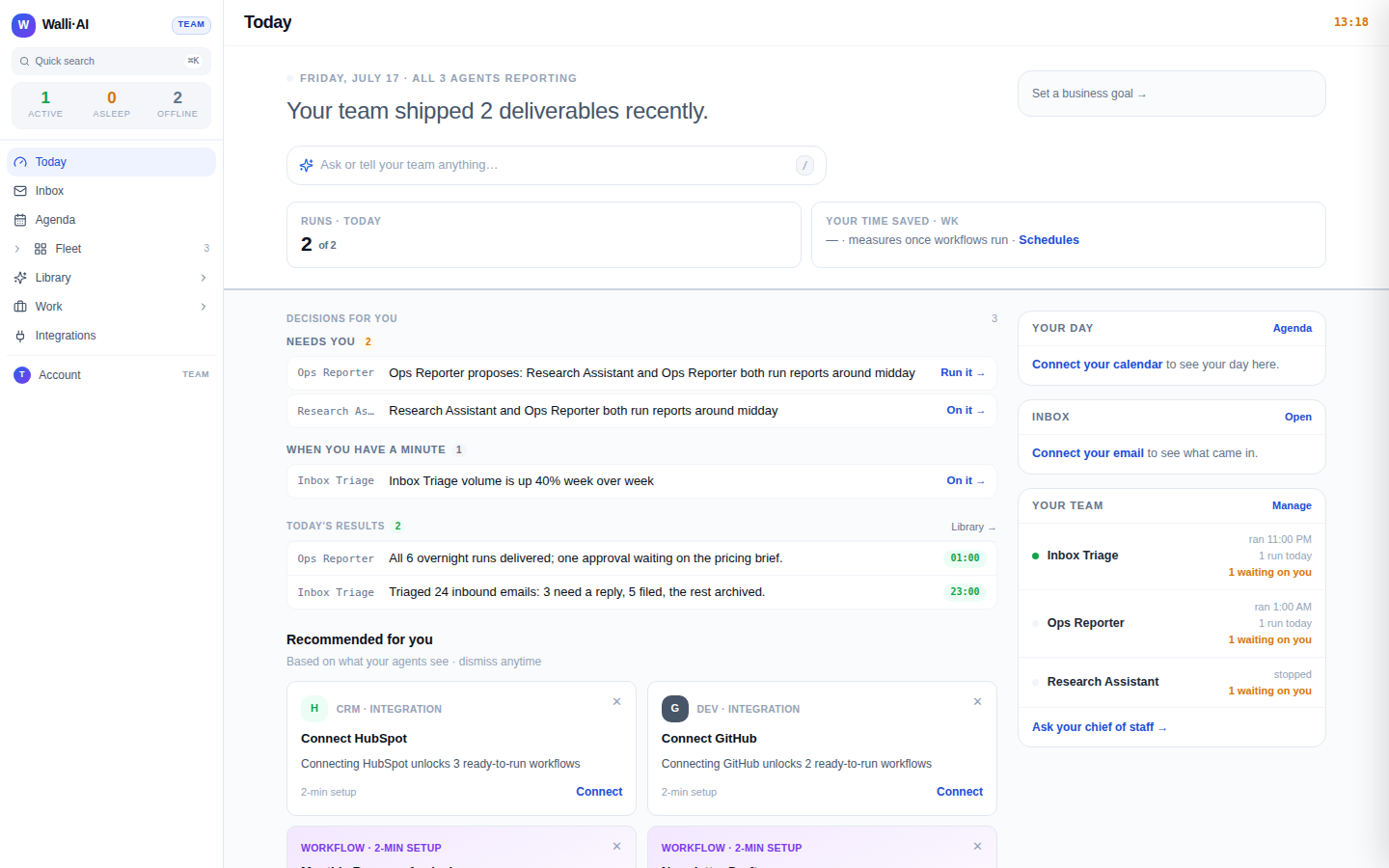
- Start every day on the Today screen, which opens with a brief, a decision queue, and proof of what got handled while you were away.
How the platform fits together
Walli-AI is built in layers, and knowing the shape helps you find the right screen.
- Agents are the workers. Each one has a name, a role, an AI model, and a set of skills and connected tools. You talk to an agent in chat, or you point a schedule or channel at it and let it run on its own.
- Workflows are the repeatable jobs an agent performs: a triage pass, a report build, a follow-up nudge. Workflows produce a structured result (a headline, a next action, and a deliverable) rather than a wall of text.
- Schedules fire workflows on a cadence (cron-precise) and self-tune when they start failing.
- Channels / Integrations connect your outside tools. Credentials are encrypted per agent, and outbound calls run through an allow-list you approved.
- The data suite (Tables, Reports, Dashboards) is a real database your agents share with you. Import a CSV and you have linked tables with computed columns and automations; build reports without SQL; pin dashboard widgets to Today.
- Today and the intelligence layer surface what matters: decisions waiting on you, anomalies, cost spikes, dropped follow-ups, and quality dips, each with a proposed fix you can approve or dismiss in one click.
Where results land
Agents do not just answer in chat and disappear. Their output is collected so you can find it later.
- Every workflow run is visible in the Runs explorer with its status, cost, output, and any errors.
- Every finished deliverable lands in the Library, a browsable record of outputs with an approval trail.
- Files an agent generates or collects are stored under Files.
- The headline of each run flows up to Today so your morning brief reflects what actually happened overnight.
This is what the platform means by "reports for duty": you open Today and see the decisions that need you at the top and the work that was already handled below, with a link to the evidence.
Memory and intelligence
Most AI tools start every conversation from zero. Walli-AI agents keep long-term memory of your business: decisions, people, companies, and deals persist across sessions, and that memory is relevance-gated so an agent recalls what matters to the task in front of it and skips what does not. On top of memory sits a proactive intelligence layer that notices patterns you did not ask about (an invoice that is unusually high, a follow-up that has waited too long, a cost that spiked) and proposes what to do about it. You stay in control: you approve or dismiss, and your verdicts stick.
Models: Spark or your own key
You do not have to bring your own AI provider. Walli-AI Spark (shown in the picker as Walli Spark) is managed inference: pick a model and the platform handles the plumbing and meters usage against your plan's included tokens. If you would rather use your own account, BYOK ("bring your own key") lets you plug in a provider key per agent. You can mix the two across your fleet. See Changing an agent's AI model or provider for how to switch.
Security and isolation
Isolation is enforced structurally, not by convention:
- Per-session micro-VMs give each agent session (and each code run) hardware-isolated compute with no network egress by default.
- Row-level security enforces tenant isolation for Tables inside the database engine itself.
- KMS-encrypted credentials protect BYOK keys, bot tokens, and API credentials, scoped per agent and never shared across tenants.
- Allow-listed egress means agents reach only the hosts you approved, re-checked at request time.
- MFA and passkeys are available on every plan, roles and permissions and the audit log are on every plan, and SSO is on the Business and Scale plans.
Tips
- If you are brand new, the fastest path to value is to hire your first agent and give it one concrete job, then check Today the next morning.
- Think in terms of "what should run on a schedule" as much as "what do I want to ask right now": scheduled workflows are where Walli-AI does its quietest, most valuable work.
- Use the navigation guide to learn where each surface lives before you dig in.
The single best habit is to start your day on Today. It is designed so the first thing you see is what got done, what needs a decision, and what to do next.