Daily intelligence
A fleet of agents produces more output than any owner can read. This is the layer that reads it for you and tells you the three things that actually need a person.
Most tools in this category stop at the agent. You get output, and reading it becomes your new job. The intelligence layer exists to stop that happening: it watches what your agents produce, decides what matters, and puts that in one place.
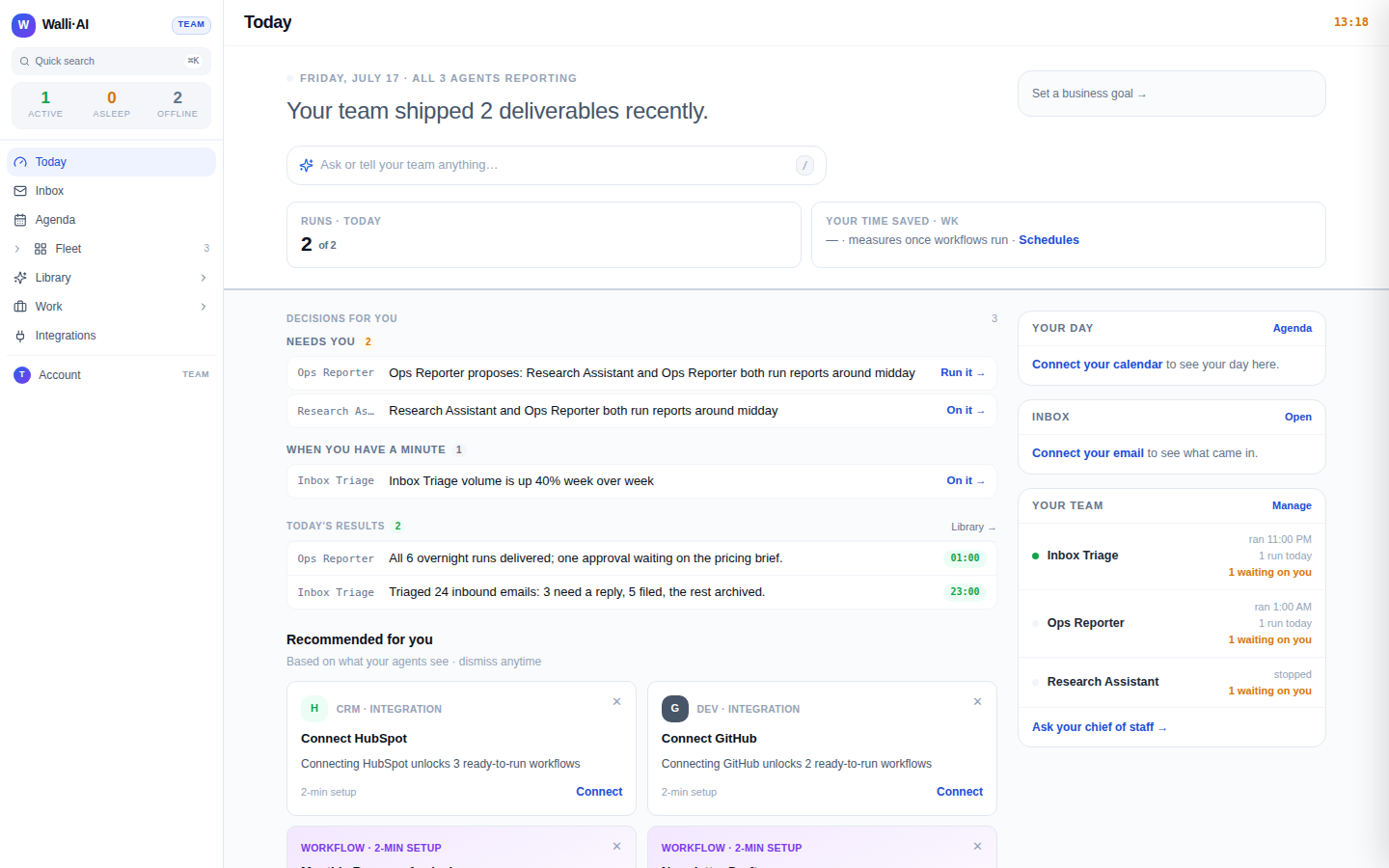
One screen, ranked by consequence.
Today is not a dashboard of charts. It is a queue. The platform pulls from every source it has, runs needing approval, things it noticed, follow-ups it wants to propose, issues it found, connections that broke, and turns them into one ranked list of decisions. Everything else on the page is context for that list.
The headline sentence at the top is written fresh for your workspace from what actually happened, not assembled from a template.
It reaches you where you already are.
A morning brief
Lands in your inbox on your own schedule, in your timezone, exactly once per day even if the system retries. You do not have to log in to know where things stand.
An end-of-day brief
Closes the day: what shipped, what is waiting on you, and what failed.
A Friday digest
Describes trajectory rather than state. This week against last week, so you can see whether things are improving or quietly sliding.
While you were away
Come back after a weekend or a holiday and the page leads with what changed since you last looked, ranked by consequence, instead of the current state with no history.
Eight kinds of thing, surfaced without being asked.
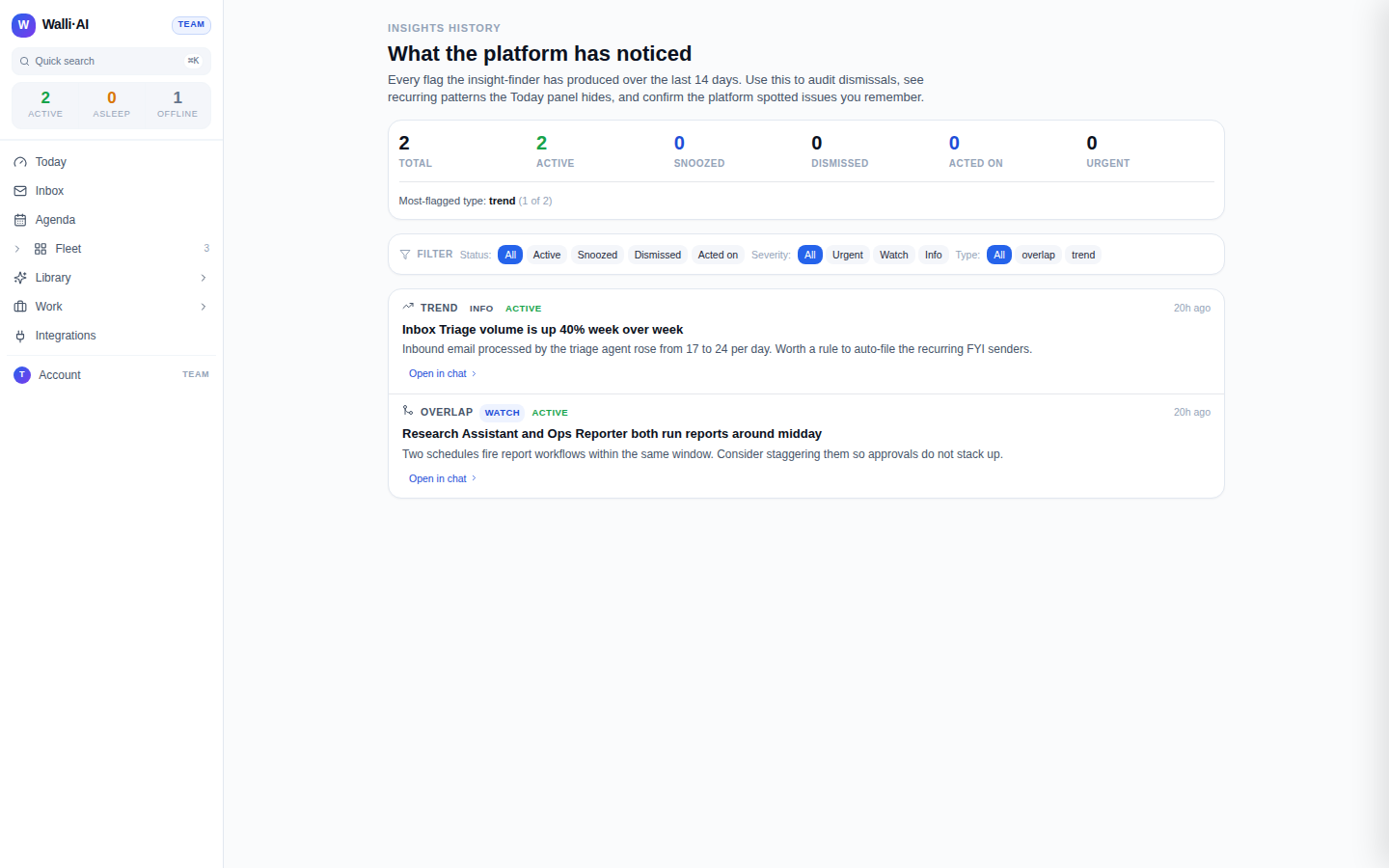
A number that jumped or cratered. A pattern building across several runs. Two agents doing overlapping work. Something proposed a while ago that never got followed through. A job that keeps needing a tool it does not have. Two schedules colliding. A cost spike. A drop in output quality.
The last two are worth calling out: they are computed by plain code rather than written by a model, precisely because money figures and quality scores are the two things you must never let an AI invent.
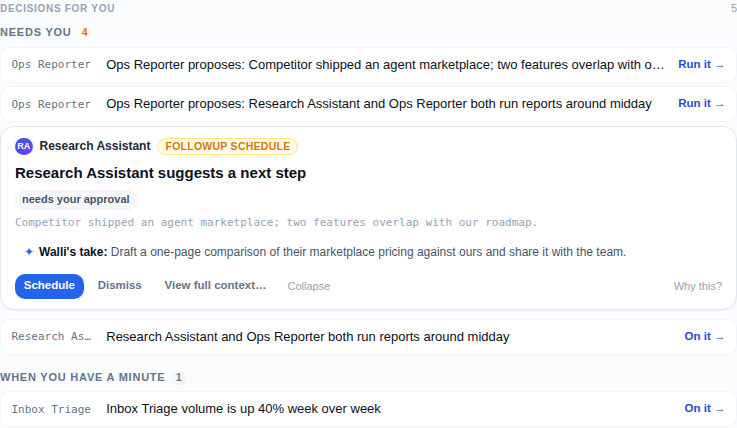
It offers to do the next thing.
When a run finishes and the agent already knows what should happen next, waiting for you to remember is a design failure. Instead the platform proposes that next step on Today, with the context attached, and you either take it or dismiss it.
The people, companies and deals nobody had to type in.
As your agents work, the platform pulls the named entities out of every run and conversation, people, companies, deals, projects, and keeps a running record with how often each comes up and what was last said about it. That record then feeds back into what your agents know.
The practical effect is that you can ask what is happening with a particular customer and get an answer, without anyone having maintained a CRM to make it possible.
Your inbox and your day.
Inbox
What landed overnight in your connected mailboxes, already triaged by urgency, with replies drafted and one-click archive. Sending always stays with you.
Agenda
Today's meetings from every connected calendar, and separately, a prep brief pushed to you around half an hour before each one, built from your calendar, the entity record, and the last week of context across your channels.
Messages arriving on your chat channels are categorised first, and spam, social chatter and pure notifications are stopped before they ever reach a model. That is a quality decision and a cost decision at the same time: your agent is not answering junk, and you are not paying for it to.
Give your agents something to work from.
The intelligence layer works on what your agents produce. The data layer is what they work from.
Where the data livesAll areas