Cost control
AI costs are the thing small businesses are most reasonably afraid of, because the usual answer is a meter you cannot see and cannot stop. This is the set of controls that answers that.
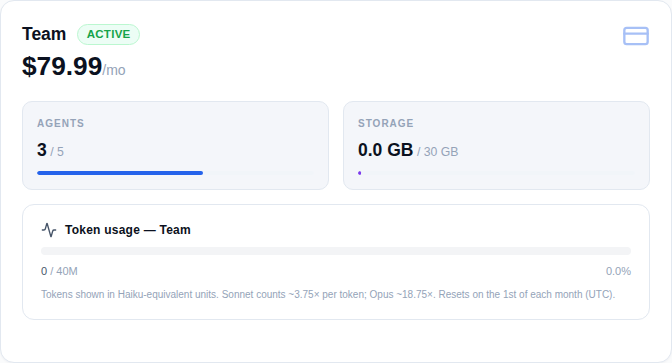
The plan price is flat and published. The only variable is how much AI your agents consume, and you decide how much of that runs on our budget rather than yours. Everything below exists to make that variable predictable, visible, and capped.
What actually stops a surprise.
Overage is opt-in, and the cap is hard
Running past your included budget does not happen quietly. You turn it on deliberately, and the ceiling you set is enforced rather than treated as a warning line.
A read-only member can never spend
Viewers cannot start a run, generate a brief, or ask the build engine for anything, because each of those costs money. Per-member caps sit on top of that.
Any agent can be capped at a model tier
The agent that runs every hour can be prevented from reaching for the most expensive model, without limiting the one that does deep research once a week.
Your own key removes the meter entirely
An agent pointed at your own provider key consumes none of your included budget. That provider bills you directly at their rates.
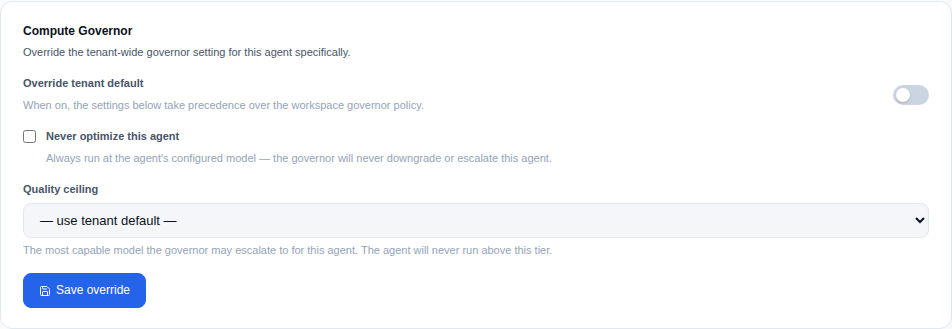
It learns which model is good enough for which job.
Most cost-saving in this category is a blunt setting: use the cheap model, accept worse answers. The governor does something better. It tracks, per kind of task and per model, how often that model actually produced an acceptable result, and routes accordingly.
That record is built from real outcomes rather than assumptions, smoothed so a model is not condemned by a couple of bad runs, and kept on a rolling window so a model that has improved is not judged on stale history. A model that keeps failing a particular workload stops being chosen for it. A model that handles it fine keeps the work, and you stop paying frontier prices for a job that never needed one.
What was spent, and on what.
A governance view reports what your agents spent and what they did over a window, broken down per agent, alongside the audit trail of every tool call they made. The two sit next to each other deliberately: cost without activity is a number you cannot act on.
What if the catalog runs out?
The last piece is what happens when what you need is not in the catalog at all.
Building your ownAll areas